Overview: Best Dynamic Microphone
Check Price:
Pros
- One of the best all-purpose mics available
- Natural Sound
- Great for Sung Vocals, Podcasting, Kick drums, Brass
- Very Little Proximity Effect
Cons
- Large size not ideal for some applications
Check Price:
Pros
- One of the best handheld dynamic vocal mics out there
- Quick transient response
- Full lower mids with great detail for vocals
Cons
- Very hot mic – requires good mic technique
Check Price:
Pros
- Iconic, warm, full sound
- Ideal for Spoken Word or Sung Vocals
Cons
- Large size not ideal for some applications
Check Price:
Pros
- Fantastic all-purpose mic
- Great for Vocals, Snares and Toms
Cons
- Included Clip is not very durable or adaptable
Check Price:
Pros
- One of the best handheld dynamic mics out there
- Comes in any color
- Modern, bright sound with excellent detail that never sounds thin.
Cons
- Requires careful mic technique
Check Price:
Pros
- Like an SM58 with more detail
- Great for live vocals
- Can be used as a utility mic
Cons
- Sensitive to plosives: requires good mic technique.
Check Price:
Pros
- Best looking mic in the world
- Has a flattering, limited response.
- Great for live vocals
Cons
- Not so versatile
Check Price:
Pros
- Great for lo-fi vocals, or any midrange-only applications
- Adds midrange cut as a second mic to any mix
- Ideal for harmonica
Cons
- Specialist mic for midrange-only applications
Check Price:
Pros
- THE utility mic that gives workable results on nearly any application
- affordable
- extremely durable
Cons
- Not as detailed as other mics on this list
Check Price:
Pros
- The most popular live vocal mic that gives workable results on nearly any application
- affordable
- extremely durable
Cons
- Not as detailed as other mics on this list
Choosing the right dynamic microphone can make a major difference—whether you’re recording a podcast in a noisy room, performing live on stage, or capturing loud instruments like drums or brass. Dynamic microphones are known for their durability, excellent noise rejection, and ability to handle high sound pressure levels without distortion.
In this guide, we’ve personally tested and compared some of the best dynamic microphones available in 2026. From studio staples to budget-friendly handheld options, each mic on this list has been evaluated for sound quality, versatility, build, and real-world performance. We’ve also included raw audio samples and practical recommendations to help you choose the best mic for your needs, whether you’re recording at home or on the road.
What is a dynamic mic?
Dynamic microphones are the go-to choice for live performances, loud instruments, and untreated recording environments. Unlike condenser mics, they don’t require phantom power, are extremely durable, and handle high sound pressure levels with ease.
They’re especially good at rejecting background noise, making them ideal for stage use, podcasting in less-than-ideal spaces, and close-miking amps or drums. While they may not capture the ultra-fine detail of a condenser, they often sound smoother and more forgiving—especially on vocals, guitar amps, brass, and percussion.
In this guide, we focus on dynamic mics that excel across multiple use cases, so you can find one that suits your needs whether you’re on stage or recording at home.
Our Testing Methods
Why Our Microphone Testing Matters
This guide is based entirely on real-world testing, not just spec sheets or marketing claims. Every mic featured here was purchased, unboxed, and tested by us—so you get an unbiased look at how these dynamic microphones actually perform across different use cases.
We focused on vocals, instruments, and podcasting, all common real-world scenarios for dynamic mics.
Dynamic Microphone Selection Criteria
We selected microphones that met the following criteria:
- Dynamic (moving-coil) microphones
- Suitable for vocals, instruments, and live performance
- Available and relevant in the 2025 microphone market
- Used by both professionals and home studio users
We excluded specialty mics like kick-drum dynamics or ribbon mics, which are covered in other guides.
Our Audio Testing Setup
To ensure consistency, each mic was tested using the same signal chain, source material, and recording method.
Audio Interface and DAW
- Interface: Universal Audio Apollo Solo
- Software: Logic Pro X
Instruments Used
- Acoustic Guitar: Martin SP000-16TR
- Electric Guitar: Fender Stratocaster
- Vocals: Male, high-range voice
Mic Placement
- Acoustic guitar: Pointed at the 12th fret, about 1 meter from the body
- Vocals: Consistent mouth-to-mic distance, without pop filters unless noted
Recording Methodology: No Processing, Just Pure Sound
All audio samples included in this guide are 100% raw recordings. We applied:
- No EQ
- No compression
- No reverb or limiting
Gain levels were adjusted per mic to peak around -12 dBFS, giving each microphone a fair, natural-sounding test.
This approach allows you to hear the true tonal character of each microphone, not a polished or processed version.
Testing Environments: Realistic Conditions
We tested in two types of environments:
- Quiet home studio space (for accurate tone)
- Naturally noisy room (to evaluate off-axis rejection and background noise handling)
This reflects common real-world setups, from home podcasters to small project studios and gigging musicians.
Why You Can Trust These Microphone Tests
We do not accept free gear or paid sponsorships. All microphones were purchased at retail, and our reviews are based solely on performance and usability—not brand relationships.
We also strive for consistency in:
- Mic placement
- Recording chain
- Performance technique
That said, results may vary depending on your room acoustics, preamp, and recording style. Our goal is to give you an honest reference point to help you choose the right microphone for your needs.
Note: We wanted to include the Heil PR35 for this review but couldn’t get ahold of one in time. (We recently reviewed the PR35, see here) Specialist dynamic mics for kick drums like the Lewitt DTP 340 REX or Heil PR48 will be considered in a different guide.
See here for our guide to mics for podcasting and voice over. See here for all of our mic reviews and info and audio gear guides.
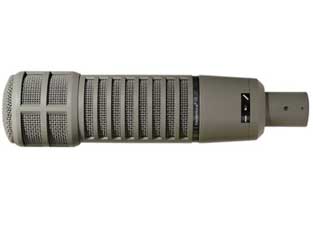
Electro-Voice RE20
our rating
4.8
Check Price:
Bottom Line:
A multi-purpose microphone with unique characteristics. Its large sweet spot, minimal proximity effect, and excellent detail, combine for a very natural sound.
A must-have in any mic locker, the RE20 is a multi-purpose dynamic mic known for its clarity and neutral response. Using what Electro-voice calls Variable-D design, the RE20 has a large sweet spot and very little proximity effect.
Applications Recommended for the Electro-voice RE20
- Podcasting, voice-over, and other spoken word applications
- Sung vocals, especially singers recording with a band in the same room.
- Loud instruments: kick drum, brass instruments, loud bass amps…
Build/Design
The RE20 is a fixed-cardioid, dynamic mic with a tank-like rugged build weighing in at 737 grams. It has a low impedance of 150 Ohms and a sensitivity of 1.5 mV.
The RE20 is equipped with an internal shockmount to reduce handling noise and a humbucking coil to guard against interference. It also has a built-in pop filter to reduce plosives.
The RE20 has an onboard high-pass filter that cuts below 400 Hz with more subtlety than most high-pass filters. It only cuts 2.25 dB off the sound as opposed to a typical -5dB.
Its innards have an output transformer, which gives it an interesting harmonic coloration that is not found in most modern dynamic mics.
Manufacturer Specs for the Electro-Voice RE20
Sound
With its balanced frequency response, nothing is over-hyped. The neutral response gives you clarity in all registers.
For spoken word applications, it gives you a silky broadcast sound out-of-the-box, with no fiddling necessary. This makes it one of the most popular broadcast mics around.
For sung vocals, the RE20 can almost be used as a handheld as it is very forgiving with mic placement. The mic handles plosives and sibilance with grace, never popping or whistling. And yet, there is brilliance in the upper frequencies where other dynamic mics sound dull.
For kick drums, the RE20 gives you a natural, un-hyped sound. That goes for any instrument you use it on. In live situations, it is the go-to mic for trumpets or brass instruments.
On the whole, the RE20 provides a natural sound that is very workable in a mix. It is utility mic with unique properties. Audio engineers are always happy to have one around.
Verdict
The RE20 is a professional-grade dynamic mic known for its smooth, neutral tone and excellent background noise rejection. Its Variable-D design eliminates proximity effect, making it ideal for consistent voice capture in less-than-perfect rooms.
Best For
Podcasts, voice-over work, close-miked vocals, kick drums, and brass instruments
Not Ideal For
Acoustic instruments that need fast transients or detailed room ambiance
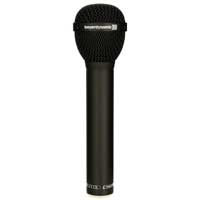
Beyerdynamic M88
our rating
4.7
Check Price:
Bottom Line:
One of the best handheld dynamic mics out there. With quick transients, detail, and thicker lower-mids, the result is silky and full.
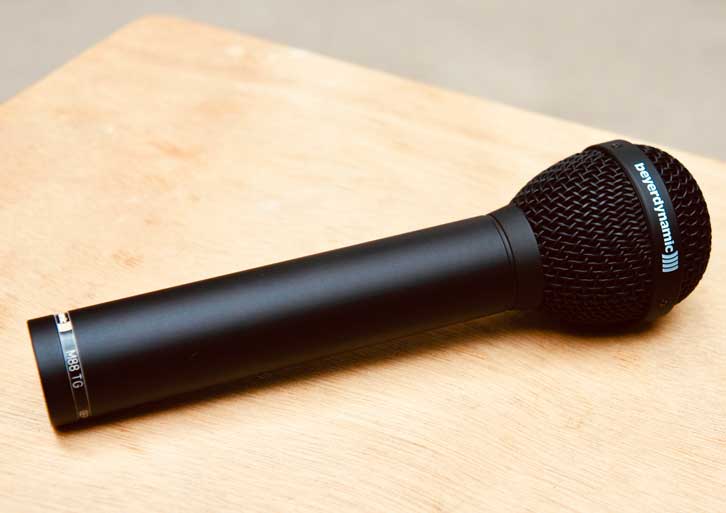
Although this hyper-cardioid dynamic mic is primarily marketed for use on kick drums, the Beyerdynamic M88 has proven its versatility as a vocal and utility mic over the years. (In some circles, it is referred to as the ‘Phil Collins’ mic, as he used it almost exclusively on his vocals.)
First introduced in 1962, this dynamic mic continues to impress on stage and in the studio.
Recommended Applications for the Beyerdynamic M88
- live and recorded vocals
- Podcasting, voice-over, and other spoken word applications
- Kick drums
- Brass, woodwinds
- Guitar amps
Build
The Beyerdynamic M88 has a tank-like build weighing in at 320g, with brass casing and a flat steel grille. Despite its heft, it’s relatively small and petite-sized.
Its capsule has a high sensitivity for dynamic mics (2.3 mV/Pa). The diaphragm is made of Hostapahan, (similar to Mylar) and the magnets are neodymium.
Despite the various versions with different letters after the ‘M88’, the mechanical and acoustic characteristics of the M88 are essentially the same. The M88 has a stronger grille than its predecessors.
Manufacturer Specs for the Beyerdynamic M88
Sound
The frequency response of the M88 TG has a significant (8 dB) lift in the upper frequencies, from 2 kHz – 15 kHz. Yet it doesn’t sound overly hyped or tinny. But the M88 TG is definitely not neutral sounding.
Overall, it has a well-produced, out-of-the-box sound. The clarity in the top is notable for a handheld dynamic mic and the lower mids are thick (nice for female vocals).
The plosives pop quite easily. The Beyerdynamic M88 is a hot mic that will need careful handling and mic technique. That said, with its hyper-cardioid pattern, the M88 is exceptional at rejecting unwanted neighbouring noise.
In our tests, the mic showed excellent consistency in its off-axis response. It sounds nearly identical at 45 degrees as it does at 0 degrees (speaking directly into the end). This is great for live vocals as you won’t need to be so careful with placement to achieve a consistent sound.
As a utility mic, the M88 definitely can deliver. The results are a little hyped and not so neutral, but in a good way most of the time. The quick transient response of the Hostapahan diaphragm makes it an excellent choice for kick drums. The fuller lower-mids and detail made it quite pleasing for recording acoustic guitar.
Verdict
The M88 TG delivers high output, crisp transients, and a rich low end, all with impressive isolation thanks to its hyper-cardioid pattern. Its slight high-frequency boost gives vocals and instruments extra clarity without sounding harsh.
Best For
Live vocals, kick drums, podcasting, brass, and guitar amps
Not Ideal For
Users seeking a completely flat or uncolored response
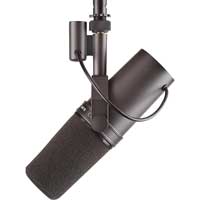
Shure SM7B
our rating
4.8
Check Price:
Bottom Line:
One of the finest dynamic mic sounds out there for sung vocals or spoken word applications.
The Shure SM7B is an industry-standard dynamic mic for the studio. Famously used to record Michael Jackson’s Thriller album, it’s been around a long time and had many names (SM-7, SM7A).
See here for a head-to-head comparison of the SM7B with the RE20.
Recommended Applications for the SM7B
- Sung vocals (studio)
- Podcasting, voice-over, and other spoken word applications
- Guitar amps
- Bass amps
Build/Design
Weighing in at 784g, the SM7B is a sizeable mic. This heft is due to its internal air-suspension shock and vibration isolator. This means you do not need a pop filter or a shockmount.
Equipped with backplate switches for bass roll-off, and presence boost (upper mids), the SM7B’s frequency response can be adjusted to fit different voices and recording spaces.
It is important to note that the SM7B requires more gain (about 60dB) from your preamp than most condenser mics. Shure recently released the SM7dB (see our in-depth review of the SM7dB), which is the same mic with an onboard preamp. This is great option to ensure you always have enough gain.
Otherwise, we recommend using a Cloudlifter if your interface or preamp doesn’t have enough juice. This is also an excellent way to provide an extra 20-25 dB of clean gain.
Manufacturer Specs for the Shure SM7B
Sound
The advantage of the SM7B is its ability to emphasize sound sources in a smooth, flattering way. The SM7B won’t give you boring, accurate reproduction. It will give you a rosy SM7B kind of reproduction.
To my ears, the SM7B is a very pleasant, warm, full mic for vocals. One of my favorite dynamic mic sounds, in fact.
The sound is less detailed, which is sometimes a good thing. Its proximity effect can be used to your advantage by simply placing the mic closer to the source for the added low end.
Many home recordists love the SM7B because it offers excellent results even in less-than-ideal acoustic spaces. Being a dynamic mic, it does very well at rejecting unwanted reflections and neighboring noise. (like all the other mics on this list)
Verdict
The SM7B remains a favorite for spoken word and studio vocals thanks to its forgiving tone, low self-noise, and resistance to room reflections. It performs well even without perfect acoustics but does require a lot of clean gain.
Best For
Podcasts, studio vocals, voice-over, electric guitar cabinets
Not Ideal For
Live performances or sources requiring ultra-detailed high frequencies
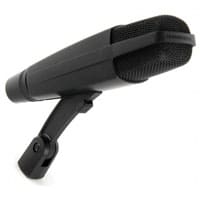
Sennheiser MD 421-ii
our rating
4.6
Check Price:
Bottom Line:
Great for spoken word, sung vocals, snares, toms, woodwinds, brass – this anonymous-looking beast is a classic, all-purpose mic. Like a fuller, more detailed SM57.
Introduced in 1960 as a broadcast mic, the Sennheiser MD 421-II is a classic, multi-purpose, stage and studio mic that you’ll find inconspicuously hiding in stages and studios around the globe.
Its name/number is easily forgotten and its look is nothing to write home about. And yet, it remains a very reliable, industry standard, all-purpose mic that delivers where it counts – sound.
Recommended applications for the Sennheiser MD 421-II
- Podcasting, voice-over, and other spoken word applications
- Sung Vocals (studio or live stage)
- Toms, snares
- Brass, woodwinds
Build
As you can see, the Sennheiser MD 421-II is not the sexiest mic out there. Square and anonymous-looking, it’s not likely to win design awards. And yet, in a certain way, it’s almost so square that it’s cool.
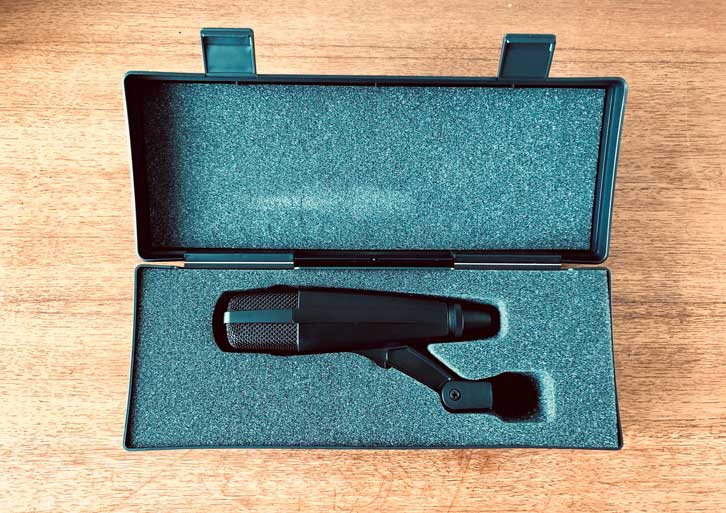
It has an all-steel casing and weighs in at 385g. It comes in the a hard-shell plastic carry case you see above.
It is sometimes difficult to get the right angle for close miking drums, which is in fact what this mic is really good at. The mic clip is the problem here.
The included clip continues to receive complaints from users. It is not that durable or adaptable. I found it annoying that I needed a screwdriver to tighten the hold just to keep it from flopping downward.
Sound
The MD 421-ii is very sensitive, listed at 2mV/Pa.
For vocal applications, this sensitivity is great but sometimes a bit on the hot side. Although I didn’t hear it happening in my monitors, the plosives pop quite a bit in our tests even with careful handling. Sibilance was well controlled by the MD 421-ii.
Elsewhere in your studio, the Sennheiser MD 421-ii can be used anywhere you might use an SM57 with a bit more detail and fullness in the results.
Its slow transient response flatters clicks and mouth sounds on horns and woodwinds. Generally, the slow transients give the MD 421-ii a warmer, rounder edge.
Verdict
A true workhorse, the MD 421-II handles high SPL sources with ease and offers a slightly warm sound that flatters everything from vocals to toms. Its unique shape and sensitivity make it versatile across genres and instruments.
Best For
Toms, snares, studio vocals, brass, and podcasting
Not Ideal For
Stereo or ambient recording situations; mic clip can be frustrating to work with
Telefunken M80
our rating
4.9
Check Price:
Bottom Line:
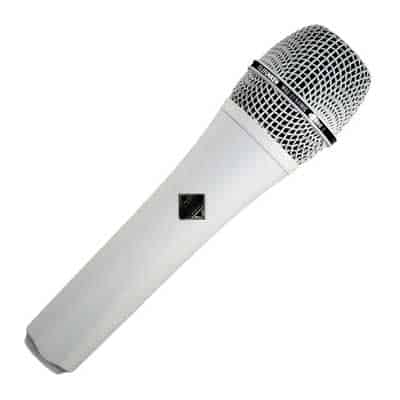
One of the best handheld vocal mics out there. Modern, bright, detailed sound, but never too thin.
Telefunken advertises the M80 as a dynamic mic with the clarity and resolution of a condenser. Curious about the validity of these claims, we tried the M80 out.
Recommended Applications for the Telefunken M80
- Sung Vocals
- Guitar and Bass Amps
Build
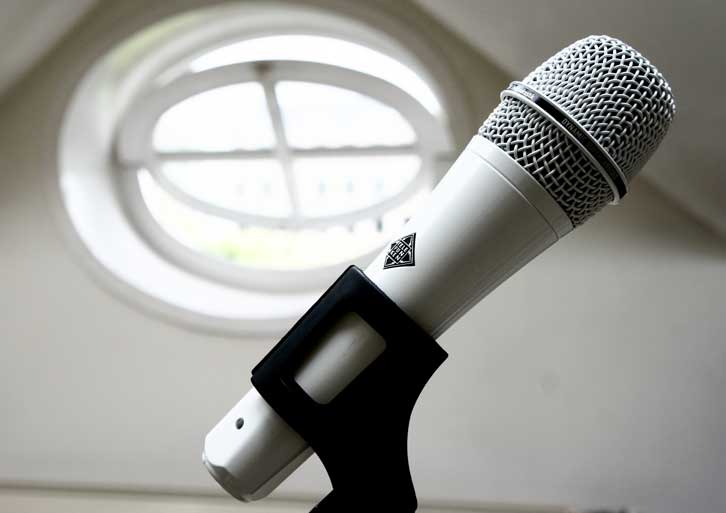
The Telefunken M80 is modeled after the trusty SM58 in its rugged build. With a steel grille, steel casing, and a slip-proof rubber coating, the M80 feels road-ready.
The M80 comes in a rainbow of colors – standard black and silver, turquoise, different woods (oak, cherry), pink, and even gold! (We reviewed the more modest white)
The innards contain a low-mass diaphragm which allows the mic a quicker transient response and higher detail resolution than most dynamic hand-held mics. And unique to this mic, the M80 has a T80 output transformer which may partially account for the lack of harshness in the detail the mic offers.
With a max SPL of 135 and a 1.54 mV/Pa sensitivity rating, the M80 fits the build of a handheld vocal mic.
Sound
With a frequency response from 50 – 18 kHz, the M80 has an obvious boost of around 7 dB from 3K-15K, which would bring edge and definition to any sound.
In our tests, however, the M80 had a bright, detailed response but never sounded tinny or overly hyped. To my ears, it is brighter than any of the other handhelds on this list, but never too thin. Along with the Beyerdynamic M88 TG, it is one of the best handheld dynamic mics I have used.
Like the M88 TG, the Telefunken M80 is not a neutral sounding mic. The results are less-than-neutral but done well: the raw sound requires very little EQ.
On acoustic guitar or as a utility mic, there are better options on this list.
Due to its thin, sensitive diaphragm, the plosives popped quite a bit. The mic definitely requires careful mic technique.
The M80 holds a very consistent, tight cardioid pattern, with very slight off-axis coloration. The Telefunken M81 is a super-cardioid version if you need more rejection of neighbouring noise, or plan to use it in club with low ceilings.
Verdict
The M80 is a dynamic mic designed for vocal detail and stage presence. Its high-end lift and fast transient response give it a modern sound signature that cuts through in live mixes or vocal recordings.
Best For
Live vocals, studio vocals that need extra clarity, stage work
Not Ideal For
Flat response applications or sources where proximity control is limited
Sennheiser E935
our rating
4.5
Check Price:
Bottom Line:
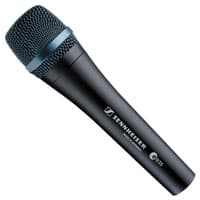
Sounds like an SM58 with more detail. Great choice for live vocals.
The Sennheiser e935, winner of the 2005 TEC award, is a popular choice among handheld vocal mics. The Sennheiser EW-500-G4-935, the wireless version of this mic, is one of the most popular live vocal mics. It comes standard with the e935 capsule.
The Sennheiser e945 is a super-cardioid version of this mic if you need more neighboring noise rejection.
Recommended Applications for the Sennheiser e935
- Sung Vocals
- Guitar and Bass Amps
Build/Design
About the same size as a Shure SM58, the Sennheiser e935 has a fairly heavy metal body (355 g). The neodymium magnets offer a high output, making this one of the hotter stage mics.
The shock-mounted capsule has a low sensitivity to impact and handling noise. The e935 is lauded for its lack of interference, due to its hum-compensating coil.
Sound
The Sennheiser E935 has noticeable detail in the upper mids. It sounds more natural than an SM58 but still has an overall dynamic mic color.
Due to its high output, the E935 requires good mic technique. Sibilance is quite controlled on the mic, but plosives can pop out if you’re not thinking about the mic position.
In the studio, it produced fairly good results on acoustic guitar and guitar amps which I wasn’t expecting. In this way, it can be used as an alternative utility mic.
Verdict
The e935 brings out vocal presence without harshness and offers excellent feedback rejection for live use. Its high output and controlled sibilance make it a solid choice for handheld vocals in high-volume settings.
Best For
Live vocalists, handheld studio use, and live sound engineers
Not Ideal For
Highly dynamic sources that require ultra-wide frequency capture
See here for our complete review of the e935.
Shure 55SH Series II
our rating
4.6
Check Price:
Bottom Line:
The coolest looking mic with an air-less, covered sound that is surprisingly lovely to listen to. Great for live vocals.
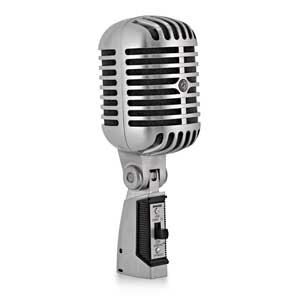
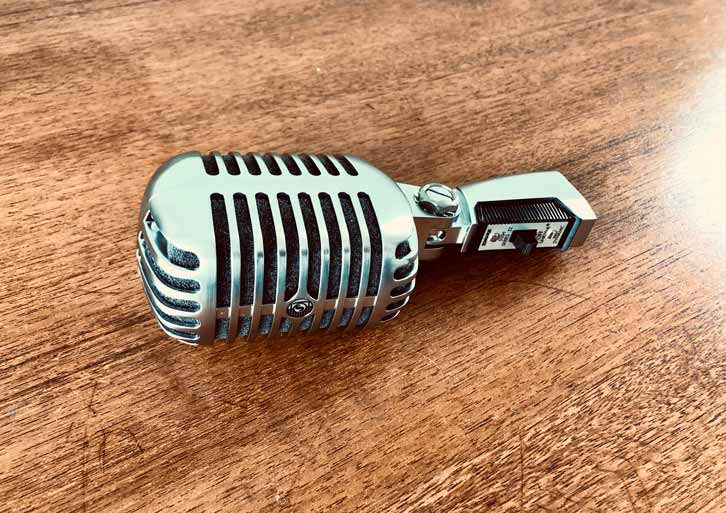
The Shure Unidyne model 55, or the ‘Elvis Mic’, first released in 1939, is still the coolest-looking mic in the world.
Used by famous folks such as Elvis, FDR, JFK, MLK, Indira Gandhi, Patsy Cline, Frank Sinatra, and Ella Fitzgerald (to name a few), the model 55 mic has a defined microphone aesthetic.
The Shure 55SH Series II is the latest incarnation of this classic.
Recommended Applications for the Shure 55SH Series II
- Live Vocals
- Spoken Word Applications
Build
The Shure 55SH Series II mic, weighs a hefty 624 g, with a chrome-plated dye casting.
The 55SH is a fixed-cardioid mic equipped with standard tools for live vocals. Handling noise is limited by the internal shockmount. The built-in pop filter controls vocal plosives. And, it has a good old on-off switch.
The series II has replaced the original capsule with a modern cardioid capsule with a low-impedance configuration.
Sound
The Shure 55SH Series II has a 9 dB boost from 6-7 kHz
The 55SH has a frequency response of 50-15kHz and has a steep roll-off at the top starting at 10 kHz. This results in a sort of air-less, covered sound, that is surprisingly pleasant to listen to.
With a 9 dB boost from 6-7 kHz, there’s a brilliant/sibilant edge to vocals not unlike the SM57. The 55SH has a large consistent sweet spot, with its full cardioid pattern. The proximity effect is quite pronounced.
Overall, I was surprised by this mic. I thought it was just a looker, but the sound for spoken word and sung vocals is much better than I thought. The response is limited in a flattering way. It won’t give you condenser-like lushness but it also won’t give you condenser-like unwanted sound reflections.
Verdict
Combining iconic design with a surprisingly warm tone, the 55SH is ideal for performers who want visual appeal without sacrificing vocal quality. Its limited bandwidth actually flatters certain vocal styles.
Best For
Live vocalists who value aesthetics and smooth midrange tone
Not Ideal For
High-fidelity studio recordings or full-range instrument capture
Shure 520DX ‘Green Bullet’
our rating
4.8
Check Price:
Bottom Line:
A specialist mic for harmonica that can do wonders in the studio. Great for lo-fi vocals and adding midrange cut to any recording.
Famous for its classic blues harp sound, this specialist mic for harmonica players has become a stage and studio favorite. Don’t let the label fool you – this is more than just a harmonica mic.
The frequency response is officially 100 Hz – 5 kHz, but with severe roll-offs on the top and bottom, it is more like 500 Hz – 4 kHz. In other words, midrange only.
Seeing how everyone wants to do takes with a Green Bullet these days, we had to include this green gem on this list.
Recommended Applications for the Shure 520DX
- Harmonica
- Live and Studio Vocals (lo-fi, old radio effect)
- Used as a second mic on any application where you want midrange punch. With a detailed condenser and this mic mixed, you can achieve some great results.
Build
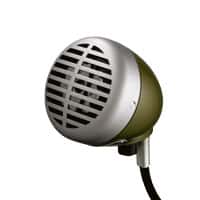
The 520DX looks like an art-deco grenade. Contoured to fit between a harmonica and your hands, it is a heavy piece of metal. (737g) It looks as if it will last your lifetime and your grandchild’s.
The volume control allows immediate control of the Green Bullet’s high output. Unfortunately, this gets in the way of a standard mount, but special 520 DX mounts are available.
With a permanently attached cable, the Green Bullet is wired for high-impedance, un-balanced operation with a 1/4-inch jack.
The mic can also be rewired to connect directly to a low-impedance device (like a mixer).
Manufacturer Specs for the Shure 520DX.
Sound
The sound of the Green Bullet holds a special place in my heart. It does the whole midrange lo-fi thing really well, from source. Capturing expression and color in its own way, it’s not simply a ‘cheap mic’ sound
In our test examples, you can hear it on solo voice and acoustic guitar. But using it as a second mic to mix in is really where this mic shines. This technique can be applied to drum ambiance, guitar amps, vocals, and anything. Adding more 520DX in a song’s bridge, for example, can bring a midrange cut.
And, by the way, it’s good for amplifying and recording harmonica.
Verdict
Originally built for harmonica, the 520DX excels at delivering gritty, midrange-focused tone. It adds vintage color to vocals or instruments and is a creative tool for lo-fi layering and effects.
Best For
Harmonica, lo-fi vocals, midrange-driven textures in studio mixes
Not Ideal For
Natural or full-range reproduction of voice or instruments
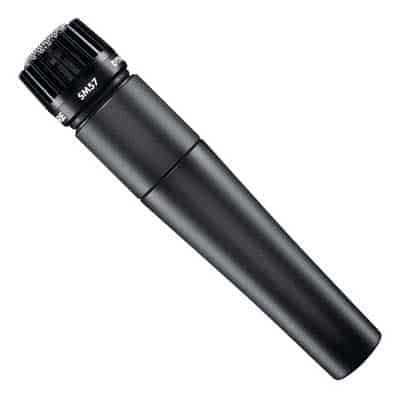
Shure SM57
our rating
4.9
Check Price:
Bottom Line:
The industry standard utility mic that can give you a workable sound on nearly any application.
The Shure SM57 is the go-to utility mic in the studio and on stage alike. It can give you a workable sound on almost any application you can think of. Like its brother, the SM58, it is famous and indestructible.
Although the SM58 is technically the ‘vocal mic’ of the two brothers, the SM57 has been used effectively as a vocal mic by many artists (John Lennon, Prince, and Drake, to name a few).
See here for a head-to-head comparison of the SM57 and the SM58.
Recommended Applications for the SM57
- Vocals
- Snares, toms
- Guitar amps
Build
With the same Unidyne III capsule as the SM58, the SM57 differs only in its grille design. The flat grille on the SM57 allows a closer, stronger proximity effect and causes a frequency response boost of around 6 kHZ, giving the SM57 more brilliance/sibilance.
The flat grille makes the SM57 more suited to guitar cabinets, snares, or any situation where an increased proximity effect might be useful.
Both mics have what Shure calls a “pneumatic shock-mount system”. This insulates the internal cartridge from mechanical vibration. As a result, Shure SM series mics have lower handling noise.
Sound
With the SM57 you’ve got a mic that records nearly anything and gives you a sound somewhere in the range of respectable to good, at a great price.
If you want to use it as a vocal mic, the Shure A2WS windscreen/grille gives you the same pop filter as the SM58.
Verdict
The SM57 is a legendary all-purpose dynamic mic that handles just about anything—amps, snares, toms, and even vocals in a pinch. While it doesn’t excel at any one thing, it performs reliably across the board.
Best For
Guitar amps, drums, general-purpose studio use
Not Ideal For
Studio vocals or detail-critical applications
Shure SM58
our rating
4.8
Check Price:
Bottom Line:
The most popular mic for live vocals. Delivers a ‘good enough’ sound in nearly any setting.
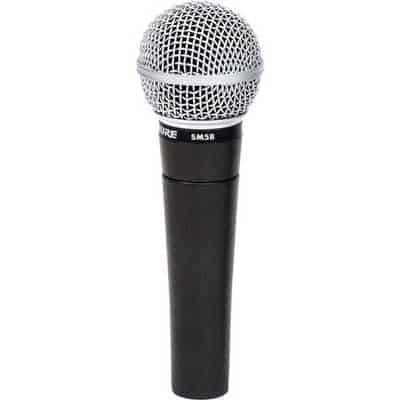
The Shure SM58 is the go-to live vocal mic, famous around the globe. It is the benchmark for handheld vocal mics. It is affordable, indestructible, and it gives quality results.
Recommended Applications for the SM58
- Live vocals
- Any situation where a workable sound will do
Shure SM58: Build
The SM58 is built like a tank and nearly all the parts are replaceable.
People have put these things in microwaves, dropped them from buildings, and frozen them in carbonite and somehow the mic still works. (Look it up if you’re bored)
The SM58 has a ball grille with a built-in wind and pop filter with a Unidyne III capsule inside.
Sound
Anything you use this mic for will provide you with a usable sound. That’s what makes it a wonder of engineering. With some EQ and compression, you could get away with this setup for a lot of gigs and recordings.
The SM58 has a lack of detail, and some complain about the ‘boxy’ sound of it. But, it will always provide a workable sound. A reliable alternative to this mic would be the Shure Beta 58A (full review of the Shure Beta 58A), which provides a bit more presence and better feedback rejection.
Verdict
The SM58 is the go-to live vocal mic, built for the road and capable of delivering consistent sound in tough conditions. It may not be hi-fi, but it gets the job done with minimal fuss.
Best For
Live vocals, rehearsals, and general use in live environments
Not Ideal For
Studio vocal recordings or applications where detail and nuance are important
Questions or Comments?
Follow the discussion here on Facebook.