Sennheiser Profile Wireless
our rating
4.5
(out of 5)
Specs Snapshot
- Frequency Response – 60 – 20,000 Hz (with low-cut: 110 – 20,000 Hz)
- Polar Patterns – Omnidirectional
- Sensitivity – (not specified)
- Self-noise – (not specified)
- Max SPL– 113 dB SPL @ 1 kHz
- Impedance – Camera output ≥1 kΩ; headphone out requires ≥32 Ω
- Weight – TX ~27 g; RX ~30 g; charging bar ~198 g
- Attenuation Pad – None
- Onboard Filter – High-pass (low-cut) — Yes; Low-pass — No
Pros
- Two-channel system with built-in storage for backup audio
- Simple pairing with no apps or complex menus
- Compatible with phones, cameras, and computers out of the box
- Integrated charging and handheld bar adds flexibility
- Touchscreen interface with clear monitoring options
Cons
- No advanced noise reduction or app-based features
- Charging bar can’t store the receiver when an adapter is attached
TL;DR Verdict
A straightforward setup and versatile design that suits a range of workflows, although it lacks a few premium features found in higher-end kits.
Check Price:
Introducing the Sennheiser Profile Wireless
The Sennheiser Profile is ideal for solo creators and two-person teams needing a plug-and-play solution with safety recording. We got our hands on this wireless mic system to see how it holds up to the competition.
Check out our gear category page for more on microphones and audio gear.
Price, Models & Release Timeline
The Profile Wireless debuted as a two-mic kit in late 2024 and was later offered in a single-mic version. The full kit includes two clip-on mics, a dual-channel receiver, and the bar charger. A more affordable single-channel version includes one mic and the same receiver and bar.
Pricing at launch was around $299 for the full kit and $199 for the single-mic option. It’s now widely available from global retailers with pricing staying close to launch levels.
Test Notes and Methodology on the Sennheiser Profile Wireless
How We Measured
All test recordings were captured using an iPhone 14, Samsung A55, iPad 11, and a Panasonic Lumix S5 camera.
Recording took place in a quiet, untreated room, and in noisier ambient conditions to simulate typical home studio use. This gave us a more complete understanding of how each mic performs in controlled and real-world scenarios.
Test Bench & Environments
Input gain was set to deliver clean recordings, typically peaking around -12 dBFS. No EQ, compression, limiting, or post-processing was applied to any of the audio clips. This ensures that what you hear is the raw, uncolored sound of each microphone.
Gear Purchased by Us
All microphones were purchased independently. We do not accept free gear or promotional samples, and we do not run sponsored reviews. Microphone placement and performance technique were kept as consistent as possible across all tests.
We fully acknowledge that microphone results can vary depending on your room, gear, and technique. Our goal is to provide a reliable, honest reference point to help you make informed decisions.
Sample Tests
Recommended Applications
- mobile videography
- podcasting
- livestreaming
- interviews
- vlogging
Alternatives to the Sennheiser Profile Wireless
Rode Wireless Pro
Built for pros, it includes timecode support, dual-channel recording, and premium accessories. A top pick for high-end video production workflows.

Check Price:
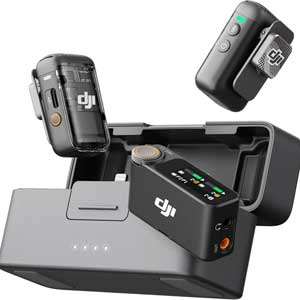
DJI Mic 2
A tough competitor with a stylish, intuitive system and features like AI noise reduction and direct smartphone pairing. A seamless, all-in-one wireless setup.
Check Price:
Rode Wireless Go 3
A compact and affordable solution with strong audio quality and 32-bit float recording, ideal for solo creators who want professional results without high-end extras like timecode.

Check Price:
See our buyer’s guide Best Microphones for iPhone for a closer comparison.
What’s in the box?
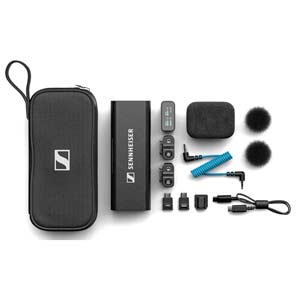
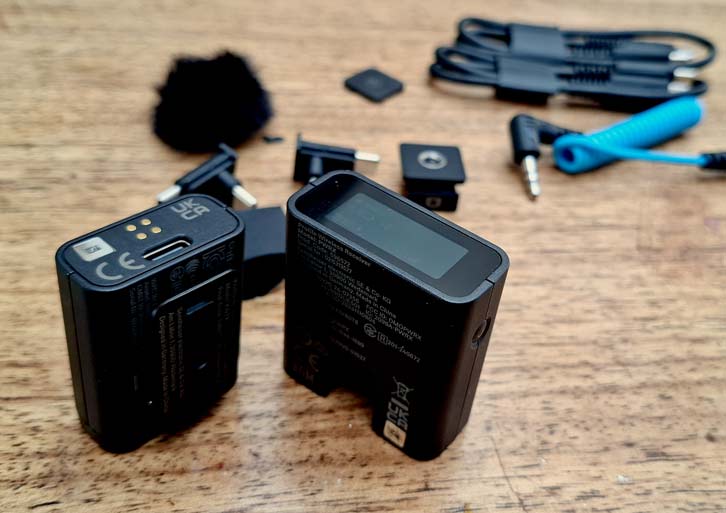
The two-channel kit provides a comprehensive setup: two transmitters with magnetic clips, a receiver with a touchscreen interface, and a battery-powered charging bar that doubles as a handheld mic.
Accessories include foam windshields, a USB-C cable, Lightning and USB-C adapters, a 3.5mm TRS cable, cold shoe and mounting hardware, and a zippered carry case.
The single-channel version (shown here below) has one transmitter and no charging bar, with otherwise the same accessories.

Design & Build Quality
The transmitters are compact and durable with integrated clips and lockable mic inputs. The receiver is light and mounts easily to various devices.
The standout is the charging bar (included with the two-channel kit), which neatly holds the system components and can be used as a handheld or tabletop mic.
The all-plastic construction is well-assembled, but some may prefer metal builds for added durability. The included case keeps the kit organized and portable.
Setup & Connectivity
I loved that the setup for these mics is quick – just remove the transmitters from the charging bar and they automatically connect. No apps or manual syncing required.
The receiver connects to phones via USB-C or Lightning adapters and to cameras using a 3.5mm cable. A headphone jack allows for live monitoring. All configuration, including gain control and channel settings, is handled through the receiver’s touch interface.
Audio Quality: Sennheiser Profile Wireless

Overall, I really liked the sound of these mics for spoken vocals. The system consistently delivers clear and natural voice reproduction in controlled environments. Outdoors and in noisy locations, it maintains intelligibility, although without noise filtering, background sounds are present.
Wind protection is decent with included foam covers, but stronger gusts require additional shielding.
The transmitters capture audio without noticeable hiss, and the gain steps allow precise level adjustments. Built-in safety channels and post-update 32-bit float recording provide added insurance against distortion.
Latency, Range & Reliability
Latency is minimal and doesn’t cause sync issues in video production. In open spaces, the wireless connection remains stable over long distances, while in crowded or obstructed areas, the range naturally decreases.
Even during occasional signal interruptions, backup recording ensures the captured audio isn’t lost.
Onboard Recording & Backup Safety
Each transmitter has internal memory capable of logging hours of audio. Recording can start manually or automatically when the signal weakens.
Files are retrieved by connecting the transmitters to a computer, making it easy to sync in post. Safety channel output delivers a lower-volume duplicate track, ideal for recovering clipped moments. The availability of 32-bit float recording further enhances dynamic range handling.
Battery Life & Charging Bar Experience
In our tests, transmitters lasted about seven hours per charge, and the charging bar provided multiple full recharges.
Charging the entire kit through the bar is efficient and supports pass-through use, meaning devices can be charged while operating. The charging bar also functions as a mic while the transmitters are docked. However, the receiver must be undocked if it has an adapter attached to fit inside the bar.
Controls, Display & Usability

The transmitters have minimal controls with status LEDs, while the receiver uses a responsive touchscreen. The interface allows quick adjustments to levels, modes, and recording functions.
LED indicators are bright and I liked that they can be disabled for discretion during filming. The menu layout is intuitive, with clear battery and signal readings. The entire kit is easy to operate without external software or apps.
Software, Firmware & Updates
The system operates independently without a mobile app. Firmware updates are available via computer and have introduced valuable features like 32-bit float recording and improved gain control.
Updates are installed by connecting the device to a computer and using Sennheiser’s desktop utility. Once updated, new options appear in the menu without altering the core functionality.
Comparisons: Sennheiser Profile Wireless vs Alternatives
Sennheiser Profile Wireless vs DJI Mic 2
Compared to DJI Mic 2, the Profile Wireless offers similar audio quality and backup recording, though it lacks active noise reduction and a metal charging case. DJI’s kit is slightly more compact but more expensive.
Sennheiser Profile Wireless vs Rode Wireless Pro
Against RODE Wireless PRO, Profile Wireless is more straightforward to use, with fewer advanced features but a simpler interface. RODE’s system offers app control and timecode sync, but Profile Wireless excels in direct usability and built-in back
Sennheiser Profile Wireless vs Hollyland Lark
Hollyland’s Lark series provides a lighter and often cheaper option, but not all models include onboard recording or full accessory support. It definitely feels like a step down in terms of build quality and overall performance.
Profile Wireless offers a more robust and professional package for those needing reliability across multiple devices.
Common Issues & Fixes
Signal dropouts may occur at longer distances or in interference-heavy areas. Keep transmitters and receiver in line of sight and enable backup recording for protection.
Audio clipping can be mitigated using the safety channel or by updating to enable 32-bit float mode.
Clothing noise is reduced by thoughtful placement and use of the included windshields.
Charging fit issues with the receiver can be avoided by removing adapter plugs before docking.
Firmware quirks are rare and usually resolved by keeping the system updated through the desktop tool.

Final Thoughts: Is the Sennheiser Profile Wireless Worth It?
This is a system for content creators who want a reliable, easy-to-use wireless setup with onboard recording and broad compatibility. In our tests, it held up to competitors like the DJI Mic 2 and Rode Wireless Go 3. It’s a solid choice for interviews, vlogging, and field recording without needing extra apps or gear.
Those requiring advanced features or ultra-compact gear might look elsewhere, but for most users, this kit offers excellent value and peace of mind.
Sennheiser Profile Wireless
Check Price:
Questions or Comments?
Join the discussion here on Facebook.
FAQ
Does Profile Wireless work with iPhone/Android without adapters? Yes, it includes both Lightning and USB-C adapters, so it connects directly to most phones.
Can it be used while charging/inside the bar as a handheld? Yes, the charging bar functions as a mic and supports pass-through charging while in use.
What’s the real-world range in urban areas? Expect reliable performance within 30 to 50 meters in busy environments, though open areas allow for longer range.
Is onboard recording 24-bit or 32-bit float, and how do you enable it? Initially 24-bit, the transmitters now support 32-bit float recording after a firmware update, which you can apply via computer.
How low is the latency and does it affect lip-sync? Latency is extremely low, well below the threshold that would cause any noticeable sync issues.
For a deeper dive on how microphones work, see our guide 3 Types of Microphones and How They Work.