Check Price:
Advantages of this Mic
- Excellent voice clarity with low noise floor
- 32-bit float internal recording saves compromised takes
- Built-in timecode for multi-cam syncing
- Lav mics and high-quality accessories included
- Long transmission range with strong encryption

Check Price:
Advantages of this Mic
- Simplified interface with touch controls
- Strong range and quick pairing
- Lightweight and easy to carry
- Charges via compact travel case
- Microphone quality is solid for speech
Check Price:
Advantages of this Mic
- 32-bit float internal recording with safety track
- Works intuitively out of the box
- Clean, natural vocal sound with low self-noise
- Intuitive touchscreen scroll wheel receiver
- All-in-one metal charging case; up to ~18 hours total runtime
Check Price:
Advantages of this Mic
- Two-channel system with built-in storage for backup audio
- Simple pairing with no apps or complex menus
- Compatible with phones, cameras, and computers out of the box
- Integrated charging and handheld bar adds flexibility
Check Price:
Advantages of this Mic
- Phone powered mic, no need for an audio interface
- Multiple pickup patterns
- MOTIV App is easy to use and works with Android and IOS

Check Price:
Advantages of this Mic
- Records internally in 32-bit float format (and 24-bit)
- Receiver compatible with both Lightning and USB-C for iPhones
Modern iPhones record decent audio, but an external microphone dramatically elevates sound quality. The right mic brings out detail, depth, and clarity that built-in options simply can’t match.
This guide explains why external mics matter, what to consider when buying one, and highlights six of the best iPhone microphones available today.
We reviewed 6 of the most popular mics for iPhone to see how they compared.
See our gear category page here for all of our audio gear reviews.
Do You Need an External Microphone for Your iPhone?
While convenient, the internal microphones on iPhones are limited by their small size and fixed design. External microphones, by contrast, can produce clear, professional-grade recordings that make a major difference in podcasts, interviews, or music sessions. Using one also gives you greater control over how and where your sound is captured.
High-quality external microphones allow for adjustable gain and polar patterns, such as cardioid or omnidirectional settings, to target a voice or instrument and reduce background noise. This makes them essential in crowded or windy environments.
By focusing the pickup pattern, these mics isolate your main subject and reduce the interference of surrounding sounds, resulting in crisp and distraction-free audio.
In practical terms, external microphones provide several advantages:
- Audio Quality: Professional mics use larger diaphragms and higher sampling depth to reproduce sound more accurately.
- Noise Reduction: Directional designs and included windshields limit unwanted ambient noise.
- Placement Flexibility: Being able to clip, mount, or position the mic closer to the source enhances clarity and balance.
How to Choose the Best Microphone for iPhone: Buyer’s Guide
Finding the right iPhone microphone depends on what you record, how you record it, and your preferred workflow. Here are the essential considerations before you buy.
Microphone Type
iPhone-compatible mics generally fall into three main styles:
Lavalier (lapel) microphones: These compact clip-on mics connect via 3.5 mm jacks or adapters. Mics like the Rode Wireless Pro come with lav mics included.
Because they can be placed near the speaker’s mouth, they capture clear, consistent vocal tones, making them ideal for interviews or on-camera dialogue.
Shotgun or directional microphones: Small directional models point directly at the sound source, which helps isolate your voice while filtering out background chatter or street noise. They are common among vloggers and mobile filmmakers.
Wireless microphone systems: These include a transmitter (with a mic built in or attached) and a receiver that connects to your iPhone. Most of our favourite mics for iPhone reviewed here fall into this category.
Wireless systems remove cable clutter and are perfect for moving subjects, multi-person interviews, and outdoor shoots.
Connectivity and Compatibility
Different iPhone generations use different connectors, so check which version suits your device:
- USB-C vs. Lightning vs. 3.5 mm: Current iPhones (15 series and later) feature USB-C ports, while older ones rely on Lightning. Many microphones include interchangeable cables for both. Analog mics with 3.5 mm plugs require Apple’s adapter to connect to newer phones.
- Always confirm compatibility—especially if using third-party adapters—to avoid connection issues.
App Support
Some digital microphones pair with dedicated apps that let you fine-tune settings. For instance, control software can let you adjust gain levels, apply EQ, or choose pickup patterns. Most video and recording apps automatically recognize external mics once connected.
Audio Specifications and Features
When comparing microphones, keep an eye on these technical details:
- Recording Formats: Premium wireless kits often support 24-bit or 32-bit float recording, providing high dynamic range and a backup copy in case of clipping or dropouts.
- Polar Patterns: Selectable pickup modes (such as stereo, cardioid, or bidirectional) make a mic adaptable to different environments. Lavalier models are typically omnidirectional, capturing even sound from all directions.
- Battery Life: For wireless systems, longer operation times reduce interruptions during long shoots. Many offer around 10–12 hours per charge, with cases that can recharge the transmitters several times.
- Accessories: Some packages include essentials like charging cases, windshields, cables, clips, and even monitoring headphones. Having these bundled saves both time and money.
Portability and Price
Compact designs such as clip-on wireless mics or small plug-in condensers are best for creators who film on the go. Larger systems cost more but include added storage, advanced controls, or durable builds. Consider whether you prefer a simple plug-and-play tool or a feature-rich professional setup.
Matching your recording style with the right type of mic ensures you’ll get great sound without unnecessary complexity.
How We Tested These Mics
How We Recorded
Test recordings were captured using the following devices: Panasonic Lumix S5-II camera, iPhone 14, and a Samsung Galaxy A55. Each microphone was used to record the same core sources.
Recording took place in a quiet, untreated room, and in noisier ambient conditions to simulate typical home studio use. This gave us a more complete understanding of how each mic performs in controlled and real-world scenarios.
Gain Settings and Signal Chain
Input gain was set to deliver clean recordings, typically peaking around -12 dBFS. No EQ, compression, limiting, or post-processing was applied to any of the audio clips. This ensures that what you hear is the raw, uncolored sound of each microphone.
Keeping It Consistent and Honest
All microphones were purchased independently. We do not accept free gear or promotional samples, and we do not run sponsored reviews. Microphone placement and performance technique were kept as consistent as possible across all tests.
We fully acknowledge that microphone results can vary depending on your room, gear, and technique. Our goal is to provide a reliable, honest reference point to help you make informed decisions.
Rode Wireless Pro
our rating
4.8
(out of 5)
Bottom Line:
Built for pros, it includes timecode support, dual-channel recording, and premium accessories. A top pick for high-end video production workflows.
The RØDE Wireless Pro represents the brand’s flagship wireless system, built for professional creators. Each of its two transmitters offers 32-bit float internal recording with more than 40 hours of onboard storage, ensuring nothing is lost to interference or clipping.
We loved that the kit comes fully loaded with windshields, a charging case, lavalier mics, and adapters for phones, cameras, and computers. Both transmitters include integrated microphones as well as locking jacks for external lavaliers.
The system features encrypted 2.4 GHz transmission with a range of up to 260 meters. Integrated timecode support helps synchronize multi-camera shoots seamlessly.
If you’re an amateur or only shoot occasionally, the features may be more than you need. It’s priced for professionals and assumes you’ll be working in fast-moving, unpredictable audio environments.
For those working in professional audio or video production, the Wireless Pro is a serious tool that brings real peace of mind. With internal recording, timecode sync, locking connectors, and a robust feature set, this mic is one of our top picks for iPhones.
See here for our complete review of the Rode Wireless Pro.
Spoken Word Test, Rode Wireless Pro
Rode Wireless Pro Test with Lav Mic attached
Rode Wireless Go 3
our rating
4.7
(out of 5)
Bottom Line:
A compact and affordable solution with strong audio quality and 32-bit float recording, ideal for solo creators who want professional results without high-end extras like timecode.
The third-generation Wireless Go offers a lightweight and intuitive two-person wireless system. It includes two tiny transmitters with built-in omnidirectional mics and a receiver that mounts easily to your phone or camera.
Like its premium sibling, it records 32-bit float audio to prevent distortion and supports transmission up to roughly 850 feet. Setup is effortless, thanks to automatic pairing and a simplified interface.
The companion app provides expanded configuration options, while the new design focuses on speed and ease of use. Perfect for vloggers, journalists, or small production teams who want dependable sound in a compact package.
Pros: Simple operation, long range, dual recording protection, very portable.
Cons: External lavalier microphones sold separately and limited onboard storage.
See here for our complete review of the Rode Wireless Go 3.
Spoken Word Test, Rode Wireless Go 3
DJI Mic 2
our rating
4.7
(out of 5)
Bottom Line:
A tough competitor with a stylish, intuitive system and features like AI noise reduction and direct smartphone pairing. A seamless, all-in-one wireless setup.
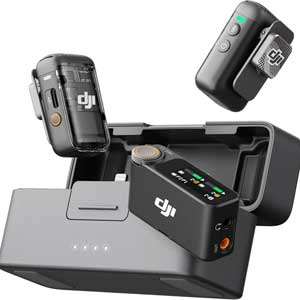
DJI’s Mic 2 kit balances strong performance with affordability. It includes two transmitters, each capable of 32-bit float recording, and a receiver that docks neatly into its charging case.
Active noise cancellation, magnetic clips for easy placement, and a wireless range of over 800 feet make it versatile for different recording conditions.
We liked how user-friendly the DJI Mic 2 was. The case integrates Lightning and USB-C connectors, and it works instantly with any iPhone model.
Build quality is solid and rugged. The transmitters feel sturdy as does the charging case and its hinges.
Battery life lasts several hours, and the intuitive interface lets users start recording quickly. The overall package provides high-quality sound and flexibility at a mid-range price point, making it one of our favourite choices for mobile creators.
See here for our full review of the DJI Mic 2.
Spoken Word Test, DJI Mic 2
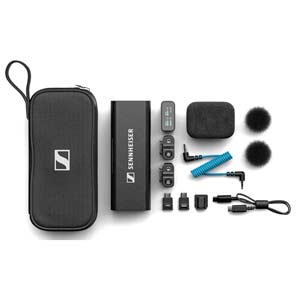
The Sennheiser Profile Wireless is a premium dual lavalier kit with studio-level fidelity. Each transmitter records in 32-bit float format, giving tremendous dynamic range and safety against clipping.
Its bar-shaped charging case doubles as a handheld mic for quick field use, and all necessary cables and adapters come included. Like the DJI Mic 2, it automatically begins internal recording if the wireless signal drops, ensuring uninterrupted audio capture.
I was a fan of the audio results from this system. The system’s sound character reflects Sennheiser’s signature balanced tone, making it suitable for interviews, streaming, and professional content creation.
See here for our complete review of the Sennheiser Profile Wireless.
Spoken Word Test, Sennheiser Profile Wireless
Shure MV88+
our rating
4.4
(out of 5)
Bottom Line:
A phone-powered, dynamic mic with surprisingly good sound. Ideal for field recording and interviews.
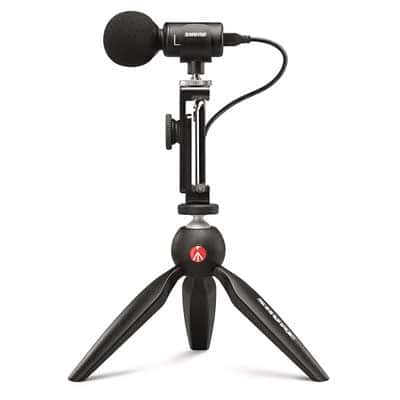
The Shure MV88+ Video Kit is a small yet capable condenser microphone that attaches directly to your iPhone. It captures sound in stereo or mono, with selectable pickup modes including cardioid, bidirectional, and mid-side configurations.
Its all-metal construction feels sturdy, and it comes bundled with a tripod, cables, and monitoring headphone jack.
This mic excels in scenarios where you want studio-level fidelity in a pocket-sized form, such as podcasting, solo vlogging, or recording acoustic performances.
The MV88+ can be purchased by itself or as the MV88+ Video Kit which includes lighting and USB-C cables for connecting to a phone. It also works with an iPad with limited features (gain adjustment only) on the MOTIV App.
Videos can be made directly with the free Shure MOTIV Video App. Sadly, these videos can only be shot in portrait orientation. If you’re working with audio only, the MOTIV Audio App is very easy to use and works as it should.
Shure have succeeded in making a quality mic that can be powered by a phone. That’s no small achievement. On the whole, the MV88+ offers fantastic value and performance for a phone/tablet mic.
Hollyland Lark Max 2
our rating
2.0
(out of 5)
Check Price:
AmazonBottom Line:
A feature-packed wireless kit with noise-cutting, backup recording, and long range. Unfortunately, it doesn’t meet the standard of the competition.
The Lark Max 2 is a budget-friendly dual wireless lavalier system designed for creators who want convenience without sacrificing quality. It includes two clip-on transmitters, each with built-in microphones, and a receiver that connects to both USB-C and Lightning ports.
It records 32-bit float audio at 48 kHz, ensuring clean, detailed sound. Each transmitter also has internal backup recording with timecode, so even if the wireless link fails, your audio is safe. Intelligent noise reduction and automatic gain control help balance voices in real time.
The compact charging case provides extra battery life—up to roughly 11 hours per transmitter and 36 hours total with the case.
This system offers a lot of bang for the buck, but we didn’t like the build quality. It looks and feels cheaper than competitors like the Rode Wireless 3 or the Sennheiser Profile Wireless.
Spoken Word Test, Hollyland Lark Max 2
Which Mic Is Best for Your iPhone: Use-Case Recommendations
Vlogging and Everyday Filming
For creators who record themselves on the move, wireless systems provide the greatest freedom. The RØDE Wireless Go 3 and DJI Mic 2 stand out for simplicity and portability.
Both attach easily to clothing and allow free movement while filming. The DJI version adds noise cancellation and safety tracks, giving extra polish to outdoor footage.
Interviews and Multi-Person Recording
If you regularly record two people, a dual-transmitter kits like the RØDE Wireless Go 3 or the DJI Mic 2 offer excellent convenience. For more demanding work, the RØDE Wireless Pro or Sennheiser Profile deliver enhanced security features, timecode integration, and internal storage for professional reliability.
Solo Content (Podcasts, Music, ASMR)
When recording alone, especially for voice-centric projects, the Shure MV88+ provides detailed stereo sound and a plug-and-play setup. Musicians and ASMR creators appreciate its ability to capture subtle nuances without extra gear.
A simple lavalier system can also work, but the MV88+ eliminates battery concerns and delivers pristine audio straight into your device.
Professional Mobile Production
For advanced creators and filmmakers who cannot risk audio loss, the RØDE Wireless Pro and Sennheiser Profile are top-tier options.
Both provide 32-bit float backup, pro-level range, and syncing features suited for broadcast and film environments. Though heavier and more expensive, their reliability and precision justify the investment.
Budget and Entry-Level Choices
Those looking to improve their audio without overspending should consider the RØDE Wireless Go 3 or the DJI Mic 2. They deliver great sound, dual-person recording, and modern features at moderate cost. Even older models like the original Shure MV88 remain excellent affordable options for entry-level creators.
I