Rode Wireless Pro
our rating
4.8
(out of 5)
Specs Snapshot
- Frequency Response – 20 Hz – 20 kHz
- Polar Patterns – Omnidirectional (TX and lav mics)
- Sensitivity – -38 dB (1V/Pa @ 1kHz)
- Self-noise – 22 dBA (TX mic), 27 dBA (Lavalier II)
- Max SPL– 123.5 dB (TX mic), 106 dB (Lavalier II)
- Impedance – 2.2 kΩ (Lavalier II)
- Weight – 5 g (TX), 36 g (RX), 177 g (charging case)
- Attenuation Pad – none
- Onboard Filter – High-pass filter selectable at 75 Hz or 100 Hz via app
Pros
- Excellent voice clarity with low noise floor
- 32-bit float internal recording saves compromised takes
- Built-in timecode for multi-cam syncing
- High-quality accessories included
- Long transmission range with strong encryption
- Smart power management via charging case and auto-power features
Cons
- Price point is high for entry-level users
- On-device interface is limited
- Transmitters and receiver slightly bulkier than competitors
- 2.4 GHz range can face interference in crowded environments
Bottom Line Verdict:
Built for pros, it includes timecode support, dual-channel recording, and premium accessories. A top pick for high-end video production workflows.

Check Price:
Introducing the Rode Wireless Pro
As a professional audio engineer, I’ve used a wide range of wireless microphone systems over the years. The Rode Wireless Pro immediately stood out as a superior option.
It’s the most feature-rich model in Rode’s wireless lineup to date, with 32-bit float onboard recording, timecode sync, intelligent gain adjustment, and a smart charging case that goes beyond just storing gear. Compact, portable, and surprisingly versatile, this kit is clearly built for professionals who need quality audio with minimal fuss.

About our Audio Tests on the Rode Wireless Pro
How We Recorded
Test recordings were captured using the following devices: Panasonic Lumix S5-II camera, iPhone 14, and a Samsung Galaxy A55. Each microphone was used to record the same source material to allow for easy comparisons to other mics.
Recording took place in a quiet, untreated room, and in noisier ambient conditions to simulate typical home studio use. This gave us a more complete understanding of how each mic performs in controlled and real-world scenarios.
Gain Settings and Signal Chain
Input gain was set to deliver clean recordings, typically peaking around -12 dBFS. No EQ, compression, limiting, or post-processing was applied to any of the audio clips. This ensures that what you hear is the raw, uncolored sound of each microphone.
Keeping It Consistent and Honest
All microphones were purchased independently. We do not accept free gear or promotional samples, and we do not run sponsored reviews. Microphone placement and performance technique were kept as consistent as possible across all tests.
We fully acknowledge that microphone results can vary depending on your room, gear, and technique. Our goal is to provide a reliable, honest reference point to help you make informed decisions.
Who is this mic for?
This system is clearly aimed at serious content creators, videographers, field recordists, and small production teams. Whether you’re doing interviews, multi-camera shoots, or one-take vlogs, this kit delivers reliable audio and convenient tools like the safety channel and timecode.
I found it particularly useful for capturing dynamic scenes where levels can spike or dip unexpectedly—the 32-bit float saved me more than once.
If you’re looking for a mic that specifically works well with iPhone this is one of our favourites. See our iPhone Microphone Buyer’s Guide for more info.
Recommended Applications
The Rode Wireless Pro is recommended for the following applications:
- Interviews and documentaries
- Wedding and event videography
- Corporate videos and online education
- Field reporting and ENG work
- Solo content creation and vlogging
Check out our gear category page for more on microphones and audio gear.
Alternatives to the Rode Wireless Pro
Rode Wireless Go 3
A compact and affordable solution with strong audio quality and 32-bit float recording, ideal for solo creators who want professional results without high-end extras like timecode.

Check Price:
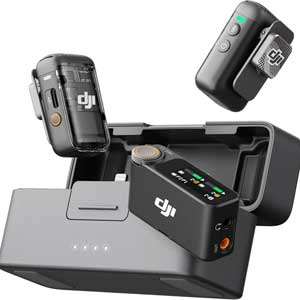
DJI Mic 2
A tough competitor with a stylish, intuitive system and features like AI noise reduction and direct smartphone pairing. A seamless, all-in-one wireless setup.
Check Price:
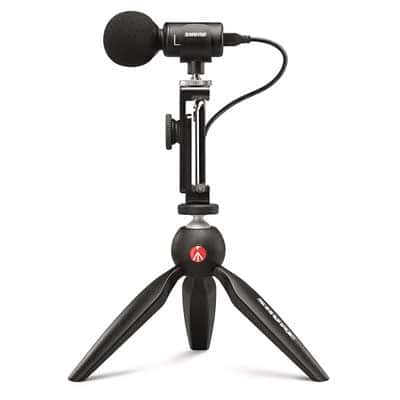
Shure MV88
A phone-powered, dynamic mic with surprisingly good sound. Ideal for field recording and interviews.
Check Price:
What’s in the box?
The Rode Wireless Pro box arrived with the following:
The Wireless Pro kit arrives fully loaded:
- Dual-channel receiver
- Two transmitters with built-in microphones
- Two Lavalier II lav mics
- Windshields for both the TX and lavs
- Magnetic mounting clips (MagClip GO)
- USB-C to USB-C, USB-C to Lightning, and TRS cables
- A smart charging case with internal battery
Rode doesn’t skimp on the accessories, and everything needed for a pro shoot is included—a real out-of-the-box solution.

Key Features
- 32-Bit Float Recording: Enables recovery of audio captured at incorrect gain levels. This internal recording captures a massive dynamic range, ensuring clean results from whispers to shouts.
- Timecode Syncing: Built-in timecode compatibility simplifies multi-cam editing by embedding consistent sync data across devices.
- GainAssist Technology: Automatically adjusts input levels in real time to help avoid clipping or under-modulation without manual intervention.
- Dual Transmitters & Receiver: Allows simultaneous two-person recording with a single receiver, ideal for interviews or dialogue scenes.
- Lavalier II Microphones: Included professional-grade lavs offer improved acoustic performance over previous bundled mics.
- Secure Audio Transmission: Operates on the 2.4GHz digital band with encrypted signal paths for stable, drop-free performance in typical environments.
- Magnetic Mounting Options: With the included MagClip GO, transmitters can be discreetly attached to clothing without needing a clip-on collar.
- Smart Charging Case: Stores, protects, and charges the entire system on the go. Also facilitates quick data transfers via USB-C.
Build / Design

Each unit is palm-sized, with a clean black matte finish. The transmitters and receiver are lightweight but feel durable. I appreciated the locking mic jacks, which held up well even during motion-heavy shooting.
The charging case has internal power and USB-C connectivity for both charging and file transfer—a very clever feature. The RX screen is small and controlled by two buttons, which can be limiting, especially in bright outdoor conditions or when wearing gloves.
For the full specs and dimensions on these mics see the official Rode Wireless Pro data sheet.

Hands-on Usage & Performance

Putting the Wireless Pro to work in various settings, I noticed how well it adapted to different production needs. In controlled studio conditions, audio captured through the Lavalier II was clean and full-bodied. Outdoors, the furry windshields minimized wind interference effectively, and I didn’t experience dropouts during line-of-sight recordings within urban environments.
Filming a conference recently, I paired the transmitters with the two presenters with the receiver mounted on my Lumix S5-II camera.
What struck me immediately was how easy it was to get these on the presenters and working. When you lift a transmitter out of its charging case it automatically turns on, as does the receiver. You don’t even have to turn them on!
Thanks to GainAssist and the safety track feature, even unanticipated spikes in volume weren’t a problem. When reviewing internal recordings later, the 32-bit float format allowed me to salvage a take that would’ve otherwise clipped.
Battery life aligned with Rode’s specs—I comfortably got through a full day of shooting with charge left in the case. The smart charging case was especially helpful for mid-day top-ups without needing to hunt for power outlets.
File transfers through USB-C were quick and seamless, and the Rode Central app was useful for deeper configuration, though I would have liked more direct control from the receiver itself.
Sound Quality: Rode Wireless Pro

In terms of fidelity, this system punches well above its weight. The Lavalier II mics included in the kit capture speech with warmth and clarity. Self-noise is minimal, and the 32-bit float capability on each transmitter lets you rescue recordings that would otherwise be unusable due to overload or low levels.
Even the built-in mics on the transmitters produce usable audio in pinch situations. The system also allows high-pass filtering at 75 Hz and 100 Hz, which I found helpful in urban environments where low-end rumble is common.
Microphone Test without Lavalier II Mic
Microphone Test with Lavalier II Mic
Rode Wireless Pro
Rode Wireless Pro Frequency Response Diagram

Final Thoughts: Is the Rode Wireless Pro Worth It?
If you’re an amateur or only shoot occasionally, the features may be more than you need. It’s priced for professionals and assumes you’ll be working in fast-moving, unpredictable audio environments. Also, in extremely crowded 2.4 GHz environments, signal interference can still be an issue, although the internal recording acts as a safeguard.
That said, for those working in professional audio or video production, the Wireless Pro is a serious tool that brings real peace of mind. It is a step above rivals like the Sennheiser Profile Wireless (full review) with internal recording, timecode sync, locking connectors, and a robust feature set make this a standout in the wireless audio market.
Rode Wireless Pro
Check Price:
Questions or Comments?
Join the discussion here on Facebook.
FAQ
How does the Wireless Pro compare to DJI Mic 2?
Both systems are versatile and high-quality, but Rode offers more internal storage and pro features like timecode. (See here for our complete review of the DJI Mic 2) DJI’s touchscreen interface is more intuitive, but it lacks some of Rode’s deeper functionality.
Is this a big upgrade over Wireless GO II?
Yes—the Pro adds onboard 32-bit float recording, timecode syncing, GainAssist, and premium lavs. It’s aimed at more advanced users who need the extra tools and reliability. The Rode Wireless Go 3 (see our complete review) offers gain assist and 32-bit but no timecode or included lav mics.
Should I choose this or the Sennheiser AVX?
Sennheiser AVX is great for plug-and-play workflows and XLR outputs, but lacks internal recording and timecode. Rode’s system is better suited for solo shooters and hybrid DSLR workflows.
For a deeper dive on how microphones work, see our guide 3 Types of Microphones and How They Work.